Apples to Apples AI: Q-Learning vs. LLMs
May 2024 – Sep 2024
- Python
- spaCy
- Sentence Transformers
- scikit-learn
- Ollama
Overview
This was a summer research project at MacEwan University, which I did with Malcolm Nielsen (opens in a new tab) and Darion Kwasnitza (opens in a new tab) under the supervision of Dr. Calin Anton (opens in a new tab). We built AI players for Apples to Apples, a party game with no right answers, and asked whether a player could learn to win it just by playing.
Each round, one player is the judge and turns over a green card with an adjective on it, like Absurd. Everyone else plays a red card from their hand, a noun like A Bad Haircut, and the judge picks whichever one they like best. Winning means matching the judge’s taste, not finding a correct answer.
We wrote up the results in a research paper (PDF) (opens in a new tab).
The players
Each player is its own program. Every round, a driver I wrote sends each player its hand and the green card, collects the cards they play, and passes those to the round’s judge, which is one of the players taking its turn. The decks hold every card from five editions of the game: 750 green cards and 2,254 red. I built four of the players:
- spaCy and SBERT play the red card closest in meaning to the green card, comparing spaCy’s word vectors or SBERT’s sentence embeddings, and judge the same way.
- Llama 3.1 and Gemma 2, LLMs with 8 and 9 billion parameters run locally with Ollama, are asked which card is most associated with the green card. They don’t always answer with a card exactly as written, so the driver asks again up to five times before falling back to a card that shares a word with the answer.
The LLMs take a few seconds to answer, so I wrote a second driver that asks every player at once. That way, a round takes as long as the slowest player instead of all of them in turn.
The Q-learning agent
The player we wanted to test learns from experience. We built it with Q-learning: it keeps a table of how much each play is worth in each situation, or state, and updates it after every round, with a reward of +1 for winning the round and −0.5 for losing. The penalty pushes it to try other cards instead of repeating ones that haven’t won. Its state is the green card plus the seven red cards in its hand.
With every card in play, that’s far too many states to learn, so I grouped similar cards together:
- I embedded every card with SBERT and clustered the embeddings with k-means, so the agent sees which cluster a card is in instead of the card itself. With 20 clusters, for example, one held actors and movie characters, and another held places.
- I ran trial games with between 10 and 100 clusters, and the agent earned the most reward with 65.
What we found
We trained the agent over 400 games against Gemma 2, Llama 3.1 and SBERT, then played 100 more games to test it. With four players, the first to win 8 rounds wins the game.
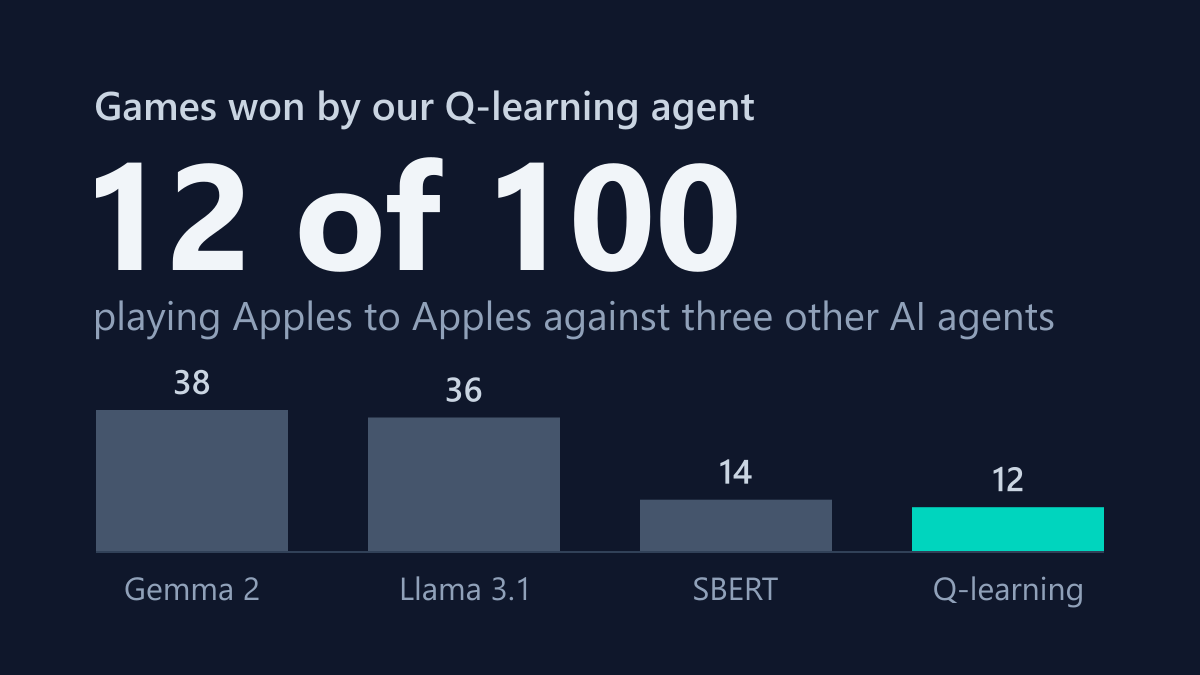
- Games won: Gemma 2 won 38, Llama 3.1 won 36, SBERT won 14 and our agent won 12. The two LLMs won 74 games between them without any training on the game.
- Rounds won: Our agent won 423 of the 2,052 rounds, the fewest of the four.
- Training: Its average reward per game levelled off within the first 100 training games and showed no upward trend after that.
Why it didn’t learn
In the paper, we put it down to two things, and the agent’s saved table backs up the first:
- Too many states. Even with clustering, a state is the green card’s cluster plus the clusters of seven red cards, which makes about 86 billion combinations. Every value in the saved table is exactly what a single update gives (0.5 for a win, −0.25 for a loss), so the agent almost never saw a state twice and never got to compare plays from the same one.
- Noisy rewards. The same card from the same hand can win or lose depending on what the other players put down and who’s judging, so even a repeated state would give mixed signals.